


How to Choose the Best Garlic Peeling Machine for Your Production
Choosing the right garlic peeling machine is an important decision for garlic processors. The suitable machine can improve peeling efficiency, reduce labor costs, protect garlic cloves from damage, and provide stable output for commercial production.
However, different garlic varieties, production capacities, and processing requirements require different machine configurations. Before purchasing equipment, it is important to evaluate several key factors.
1. Consider Your Required Production Capacity
The first step is to determine how much garlic you need to process per hour.
Small processors may only need a compact garlic peeling machine, while commercial garlic processing plants often require a continuous garlic peeling production line.
For example, you should consider:
Required capacity per hour
Daily processing volume
Number of operating hours
Future production expansion
Available factory space
Choosing a machine with slightly higher capacity than your current requirement can provide room for future business growth.
2. Choose a Machine Suitable for Your Garlic
Garlic varieties differ in bulb size, clove size, moisture content, and skin characteristics. These differences can affect peeling performance.
A good garlic peeling machine should provide stable peeling performance while minimizing damage to the cloves.
Before purchasing, it is recommended to provide the manufacturer with information about your garlic, including:
Garlic variety
Average bulb size
Clove size
Moisture condition
Whether the garlic has been pre-dried
Required peeling rate
For large projects, garlic samples can also be tested to determine the most suitable equipment configuration.
3. Check the Peeling Method
Industrial garlic peeling machines commonly use pneumatic or mechanical peeling principles. Pneumatic peeling is widely used in commercial processing because it can remove the outer skin efficiently while helping maintain the appearance of garlic cloves.
The peeling method should be selected according to your garlic characteristics and required peeling quality.
For commercial production, the goal is not simply to peel garlic quickly, but to achieve a good balance between peeling efficiency, product quality, and processing capacity.
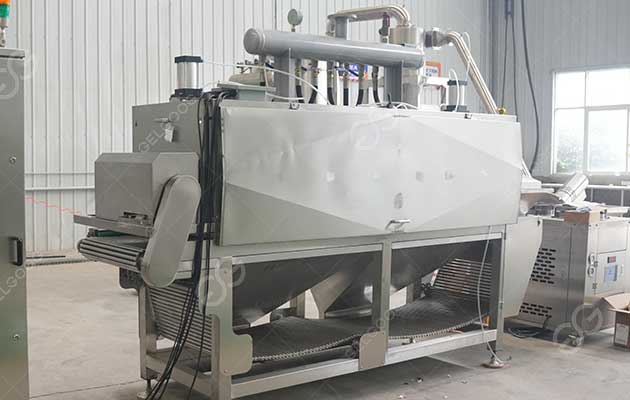
4. Look at the Garlic Damage Rate
Garlic cloves can be easily damaged during mechanical processing. Excessive impact or unsuitable machine settings may cause broken or bruised cloves.
Therefore, when comparing garlic peeling machines, pay attention to:
Peeling efficiency
Whole-clove rate
Damage rate
Peeling cleanliness
Stability during continuous operation
A high-quality machine should provide efficient peeling while reducing unnecessary damage to the garlic.
5. Consider Automation Level
For factories processing large quantities of garlic, an automatic garlic peeling line can significantly reduce manual operations.
A complete processing line may include:
Garlic feeding → Clove separation → Garlic peeling → Skin separation → Inspection → Conveying → Packing
Depending on your requirements, additional equipment can also be integrated into the line.
Automation can help reduce labor requirements, improve production consistency, and make the processing process easier to manage.
6. Consider Ease of Operation and Maintenance
A garlic peeling machine may operate for many hours every day, so convenient operation and maintenance are important.
When selecting equipment, check whether it has:
Simple control operation
Easy-to-clean surfaces
Accessible wearing parts
Reliable electrical components
Convenient adjustment
Easy maintenance procedures
Food-grade stainless steel construction is also preferred for commercial garlic processing because it is durable, hygienic, and suitable for food-processing environments.
7. Don't Focus Only on Machine Price
Machine price is important, but it should not be the only purchasing factor.
A lower-priced machine may have lower capacity, higher labor requirements, or greater maintenance costs. In contrast, a well-designed automatic garlic peeling line may require a higher initial investment but provide better long-term operating efficiency.
When calculating the total investment, consider:
Equipment cost + installation cost + labor cost + energy consumption + maintenance cost + expected production capacity
This gives you a more realistic picture of the machine's overall value.
8. Choose a Reliable Garlic Peeling Machine Manufacturer
The manufacturer is just as important as the machine itself.
A professional supplier should be able to provide:
Equipment specifications
Processing flow design
Garlic peeling tests
Customized capacity solutions
Installation and commissioning
Operator training
After-sales technical support
For large garlic processing projects, it is better to work with a manufacturer that can provide a complete garlic peeling production solution rather than purchasing individual machines from different suppliers.
9. Ask for a Garlic Peeling Test
If you are unsure which machine is suitable for your garlic, a processing test is one of the best ways to evaluate the equipment.
The test can help determine:
Actual processing capacity
Peeling efficiency
Whole-clove rate
Damage rate
Final garlic quality
This is particularly important when processing a specific garlic variety or when investing in a large-scale production line.
10. Choose the Machine Based on Your Long-Term Production Plan
The best garlic peeling machine is not necessarily the largest or most expensive model. It is the machine that matches your raw material, production capacity, product quality requirements, budget, and future expansion plans.
For small and medium-sized processors, a standalone automatic garlic peeling machine may be sufficient. For larger factories, a complete garlic peeling production line can provide higher automation and continuous production.
Final Thoughts
Choosing the best garlic peeling machine requires more than comparing prices. Production capacity, garlic characteristics, peeling efficiency, damage rate, automation, maintenance, and manufacturer support should all be considered.
If you are planning to build or upgrade a garlic processing plant, start by defining your required capacity and garlic specifications. Then work with an experienced garlic processing equipment manufacturer to design a suitable solution.
Looking for an automatic garlic peeling solution? A customized garlic peeling production line can help you improve processing efficiency, reduce labor requirements, and achieve more consistent peeling results.